
The Thin Line Between Managing, Bypassing, and Regulating: A Trauma-Sensitive Yoga Approach
How trauma-Sensitive, holistic yoga practices help you safely process feelings, rebuild the mind-body connection, and cultivate emotional resilience.


Most of us are taught that emotions are something to manage. The logic seems sound: if we keep a tight grip on our feelings, we’ll stay “in control. But in practice, many of us notice the opposite — the harder we try to manage our emotions, the worse we feel.
Managing emotions often creates tension and stress instead of true healing . Why? Because managing isn’t the same as regulating. And when you add in spiritual bypassing (the tendency to cover discomfort with positivity or “higher” thinking), it can get even trickier to discern what real healing looks like.
Trauma-sensitive yoga — a gentle, trauma-informed approach to movement and mindfulness — offers a way to safely process grief, anger, and other challenging feelings. By strengthening the mind-body connection, practicing emotional regulation, and honoring your experience as it is, trauma-sensitive yoga helps you release suppressed emotions, build resilience, and cultivate lasting mental and emotional wellness.
Let’s untangle this.
Managing vs. Regulating Emotions
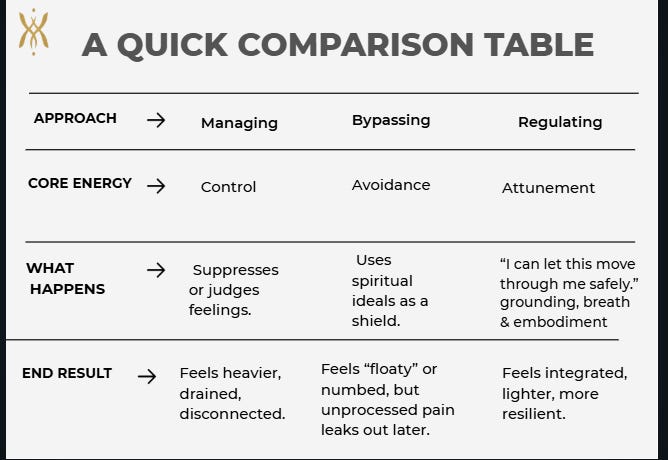
Managing emotions often sounds like strength, but it usually translates into control or suppression. Instead of processing what we feel, we police it: “I shouldn’t be this upset.” Over time, that creates a second layer of shame or tension on top of the original emotion.
Regulating emotions, on the other hand, is about attunement. It’s not about making the feeling vanish, but about creating enough safety in the body for the wave to rise and fall. Regulation works with your biology — through awareness, breath, grounding, or movement — to settle your nervous system so emotions can move through you, not get stuck inside you.
Where Spiritual Bypassing Falls In
Spiritual bypassing looks deceptively peaceful. It uses spiritual practices or beliefs to sidestep uncomfortable emotions. Instead of feeling grief or anger, we might jump to “everything happens for a reason” or force ourselves into meditation to “rise above” the pain.
It’s not malicious — bypassing is often an attempt to protect ourselves. But like managing, it resists raw feeling. The difference is that managing clamps down, while bypassing floats above. Both avoid the necessary step of being with what is real.
How Trauma-Sensitive Yoga Helps
This is where trauma-sensitive yoga comes in. It acts as a bridge between bypassing and control, guiding us into real regulation. Here’s how:
Choice over control – Invitations instead of commands restore agency, something trauma often takes away.
Interoception – Gentle awareness of sensations helps us notice how emotions show up in the body, instead of just analyzing them in the mind.
Grounding – Slow movements and breath anchor us in the present moment, preventing overwhelm or dissociation.
Rhythm– Repetitive, gentle practices cue the nervous system toward safety and repair.
Compassionate space – The practice is about curiosity, not achievement. That makes room for emotions without judgment.
In this way, trauma-sensitive yoga doesn’t force you to manage emotions, and it doesn’t ask you to bypass them. Instead, it helps you feel them in safe, digestible doses — and regulate them so they no longer run your life from the shadows.
Honoring Our Experience as It Is
One of the quietest ways we bypass our own healing is by minimizing what we feel: “It wasn’t that bad,” or “Other people have it worse, so I shouldn’t complain.” On the surface, this seems humble — but in reality, it gaslights our own body and heart out of valid emotions like betrayal, grief, or fear.
Trauma-sensitive yoga offers another path. It creates space to honor our experience exactly as it is, without shrinking or inflating it. Instead of avoiding the “elephant in the room,” we practice meeting ourselves in those raw, vulnerable places — where we feel exposed, unsafe, or hurt.
This is the work of cultivating inner safety and trust. By choosing presence over pretense, we refine the heart–mind–body connection. We stop pretending the elephant isn’t there, and instead learn how to sit with it until its weight lifts.

A Gentle Practice to Try
Here’s a simple trauma-sensitive yoga reflection you can try the next time a wave of emotion feels too much:
1. Find your ground – Sit or stand with your feet on the floor. Notice the points of contact between your body and the earth.
2. Breathe into choice – Place one hand on your belly, one on your heart. Invite a slow inhale, then let the exhale be even longer. You can choose how deep or shallow feels safe.
3. Notice, don’t fix – Ask yourself: What sensation do I feel right now? (tightness, warmth, buzzing, heaviness). Name it without trying to change it.
4. Offer kindness– Whisper silently: “It’s okay to feel this. I am safe in this moment.”
5. Close gently – Take one more breath. If it feels right, shake out your hands or stretch your arms, signaling to your body that the moment has been acknowledged and released. You may come to this practice at any point in your day when you need. It can take as little as 5 minutes.
Takeaway:
Emotions are not problems to be fixed, nor storms to float above. They are waves meant to be felt and released. Trauma-sensitive yoga is one powerful practice that lets us do exactly that — bridging the gap between “controlling” and “avoiding” so we can finally feel safe in our own home, ourselves.
Explore With Me
If this practice resonated, I invite you to explore my trauma-sensitive yoga classes. Together, we create a safe, compassionate space to meet yourself honestly, regulate emotions gently, and rebuild the heart–mind–body connection — one breath, one movement at a time.